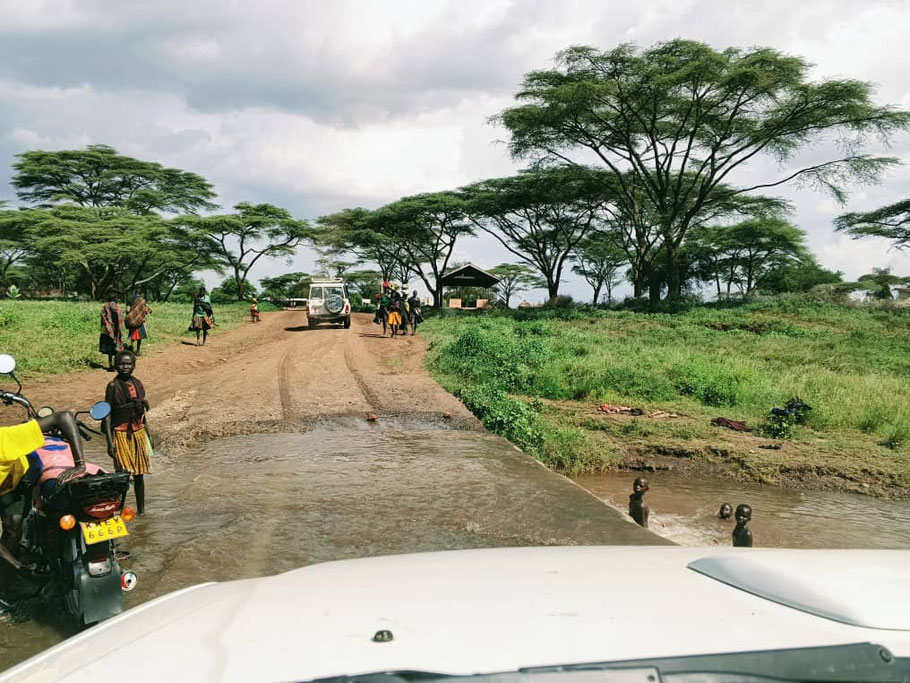
Into the far East of Uganda
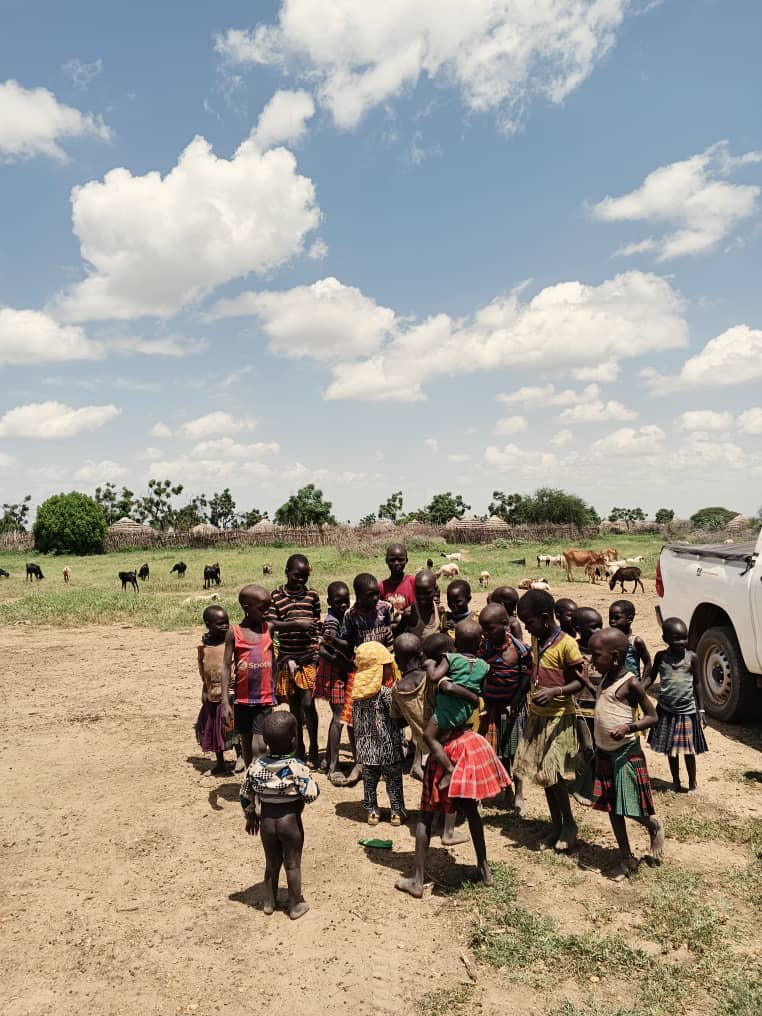
The children are the first to sit down. They watch us silently from the shade of the round huts, arranged in a wide formation as if someone had drawn them gently into the landscape with a steady hand. Behind them, the heat of Karamoja shimmers above the dry earth. A goat moves through the dust, somewhere metal strikes wood, and above everything lies that wind of northeastern Uganda—dry, yet somehow still carrying the scent of life.
Then the circle begins to close.
Women sit on small stools or directly on the ground. Men arrive from the direction of the kraal, where the animals are kept. Children press close to their mothers. Finally, we all sit there, knee to knee, in a large circle under the open sky. No one sits in front. No one sits behind. Perhaps it is exactly this circle that best describes the pastoral way of life in Karamoja. Because everything here seems organized in circular form: the architecture, the community, the seasons, the movement of animals, even the passing on of responsibility. The conversations themselves do not unfold linearly either, but move like a calm current through the group. One person speaks, the others listen. Then someone else continues. No interruption, no competition over who speaks louder or faster.
The Manyatta, the traditional homestead of many pastoralist communities in Karamoja, is also built in a circular pattern. Several small round huts made of mud and wood are arranged around a shared inner space. Outside, a dense fence of thorny branches protects the inhabitants and livestock from intruders. Inside, something else emerges: closeness.
The circles are not only for protection. They are an expression of a worldview. “Mine” and “yours” lose their meaning here. Livestock, food, responsibility, even worries are shared. Living alone would hardly be possible. Community is not a romantic idea, but a necessity. Perhaps it is precisely from this that a form of solidarity emerges that has long been lost in more individualised societies. The Karamojong are among the pastoralist communities of East Africa. Their life is deeply tied to cattle. Cows are food, wealth, social status, bride price, security for old age, and spiritual connection all at once. Yet anyone who thinks pastoralism is simply a profession does not understand Karamoja. “It is a philosophy of life,” one of the men says quietly, looking not at us but toward the horizon.
From a young age, children grow into this philosophy. Girls collect firewood, gather herbs, or pump water. Boys spend much of their time in the kraal, the protected livestock enclosure. There they learn responsibility early on. At night, the animals are kept safely inside the kraal; during the day, herders lead them to grazing lands.
But with the dry season, a new struggle begins each year. Water sources often become insufficient. Men and boys sometimes move with their herds for months through the semi-arid landscape, always searching for pasture and water. Everything in daily life is adapted to this physically demanding way of living—even the food. Meals are rich in energy, filling, and functional. Many ingredients expand in the stomach and provide energy for hours. Food here is not a lifestyle—it is survival. When we ask the oldest woman in the Manyatta how old she is, she only smiles briefly. She does not know her birthday, she says. And none of the many small children running around between the huts knows their exact date of birth either.
A day on which only one individual is celebrated?
The idea suddenly feels strangely foreign.
Instead, something else is revealed in the conversation: an enormous knowledge of climate, animals, and natural cycles. During the rainy season, the kraal is deliberately located farther away from the women’s fields so that cattle do not destroy the small cultivated plots. In the kraal itself, younger boys ensure that calves and kids are not separated too much from their mothers. Half the milk is for the young animals, the other half for the community.
Nothing is thought of in isolation. Not food. Not work. Not land. Not even the future. For hours we ask questions. We try to understand, to photograph, to document, to categorise. We wait politely until one person has finished speaking, only to ask our next question afterwards. Each of us, unconsciously, follows our own perspective, our own story, our own curiosity. It is only during the shared lunch that something shifts. Someone from our group suggests that the inhabitants of the Manyatta might also ask us questions. What happens next feels almost like a reflex.
Did you know?
The seven people do not stand up individually. No one spontaneously directs a personal question at us. Instead, they immediately sit together. Close to each other. Once again in a circle. They first speak quietly among themselves, discussing, weighing, deliberating. For minutes. And then one of them asks us a single question. A collective question. In that moment, the difference becomes unmistakable. While we visitors each asked our individual questions one after another, the Karamojong first searched for a shared voice. Perhaps this is where their greatest strength lies. Not in surviving the drought. Not in living within the harshness of this landscape. But in the natural way they place community above individualism.
One can move faster alone.
But in a circle, one goes further.